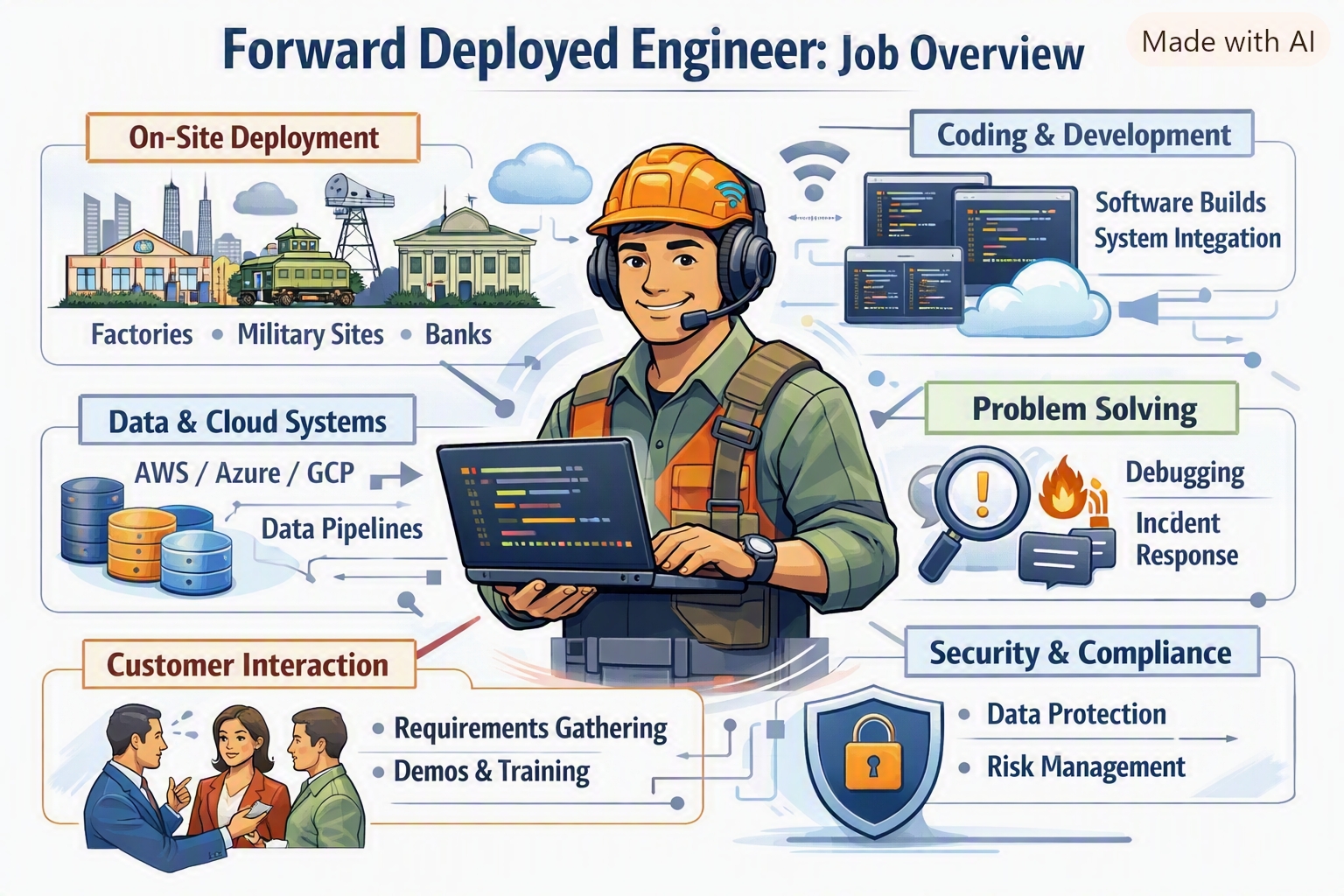
Forward deployed engineers (FDEs) work at the front lines of technology delivery — inside customer environments, solving urgent problems, and building solutions that bridge product capabilities with real‑world constraints. Today, the role is evolving fast. AI has become a force multiplier, reshaping how FDEs design, debug, deploy, and communicate. This article summarizes the essential skills an FDE must learn, and how modern AI tools amplify each of them.
Core Engineering Skills — Supercharged by AI
Software Engineering. Strong fundamentals remain the backbone of the FDE role. AI coding assistants like Microsoft Copilot help engineers write cleaner code, generate tests, and accelerate refactoring. They reduce cognitive load so FDEs can focus on architecture and customer impact.
Distributed Systems. FDEs frequently troubleshoot microservices, queues, and event‑driven systems. AI observability tools can summarize logs, detect anomalies, and highlight root causes — turning hours of manual analysis into minutes.
Cloud Platforms. Cloud providers now embed AI directly into their consoles. Natural‑language provisioning, IAM policy generation, and automated cost optimization help FDEs deploy faster and more safely across AWS, Azure, and GCP.
Practical Field Skills — Enhanced by Automation
DevOps & Infrastructure. AI accelerates pipeline debugging, Kubernetes configuration, and Infrastructure‑as‑Code generation. Tools can predict deployment failures, suggest fixes, and automate repetitive tasks — ideal for high‑pressure field environments.
Data Engineering. AI simplifies SQL generation, schema inference, and pipeline troubleshooting. It also improves data quality through anomaly detection and automated validation.
Security & Compliance. Security Copilots help FDEs detect vulnerabilities, generate secure code patterns, and map configurations to compliance frameworks — crucial when working with regulated customers.
Customer‑Facing Excellence — Powered by AI Insight
Product Thinking. AI can summarize customer interviews, extract pain points, and analyze usage patterns. This helps FDEs translate ambiguous requirements into actionable engineering decisions.
Communication. AI tools generate architecture diagrams, documentation, and executive‑friendly summaries. They help FDEs communicate clearly across technical and non‑technical stakeholders.
Rapid Problem Solving. When incidents occur, AI assistants can triage logs, propose fixes, and generate post‑mortems — enabling FDEs to respond quickly and confidently
Operational Readiness — AI in the Field
On‑Site Deployment. In restricted or offline environments, local LLMs provide secure, on‑device assistance. AI‑generated runbooks and configuration suggestions help FDEs adapt to unpredictable conditions.
Incident Response. AI accelerates crisis workflows: timeline reconstruction, mitigation recommendations, and recurrence prediction. This reduces downtime and improves customer trust.
Integration Engineering. AI helps generate API clients, convert protocols, validate payloads, and design mapping logic — perfect for environments where systems were never meant to work together.
The Modern FDE Mindset
AI doesn’t replace the forward deployed engineer — it amplifies them. The best FDEs use AI to move faster, reduce friction, and deliver higher‑quality solutions. What remains uniquely human is the ability to empathize with customers, navigate ambiguity, and take ownership of outcomes. Forward deployed engineering is becoming one of the most AI‑augmented roles in the industry. Those who embrace these tools will deliver value at a scale and speed that was impossible just a few years ago. The fact is this role is become favorite because of the AI adoption. How about you? is your organization adopt the FDE?